
By: Lori Kesten
March 11, 2026 | 5 min read
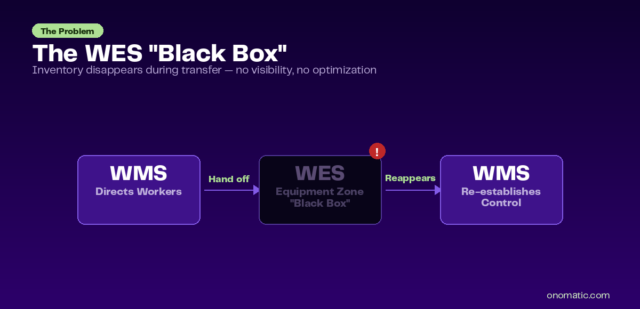
For decades, Warehouse Execution Systems (WES) have served as the connective tissue inside distribution centers and manufacturing plants. A WES coordinates material handling equipment as inventory moves through each type such as conveyors, sorters, storage systems and so on. A Warehouse Management System (WMS) directs human workers to move inventory between each piece of equipment as needed.
In practice it works like this: as directed a WMS User hands/scans inventory off to the equipment. The WES takes control of the inventory during which time the WMS treats it like it’s in a “black box”. Inventory reappears (almost magically) when the WES send notification, the WMS re-establishes control and continues to direct it along a predefined path until all steps are completed.
In an operation controlled by a WMS with a few tightly integrated pieces of material handling equipment, the traditional WES model was manageable; blind spots and all.
In the last few year Robots (AMRs) have dramatically changed the nature of automation equipment.
Robots have arrived in distribution and manufacturing environments in multiple forms, and, in many ways, this equipment type behave more and more like the human workers, in fact they often work in collaboration with humans. Think about it; AMRs move dynamically, must take breaks to re-charge, and interact with other systems in ways that are far more fluid than the fixed automation architectures of the past.
Today’s facilities often use multiple types of automation from multiple vendors: autonomous mobile robots, goods-to-person systems, automated storage and retrieval systems, intelligent conveyors, vision systems, high-speed sortation, packaging automation, and more. Each solution brings its own control system (WCS) and execution logic.
Yet in many WES controlled environments, inventory and the tasks associated with moving it are still simply handed off from one system to the next. These handoffs occur without continuous optimization based on actual system capacity or known real-time operational constraints.
The result; an environment where the traditional WES approach, built primarily on point-to-point integration, reveals its limits in the ability of the site to gain maximum value across the automation ecosystem deployed now and in the future.
Simply put.
WES Model: Connecting Systems
Orchestration Platform Model: Continuous Re-optimization of Systems
What’s In The Name: Orchestration
Warehouse and manufacturing operations are large, contain multiple forms of equipment and are always in motion. The best-run facilities strive to operate as a single cohesive system, but the truth is, they are made up of many subsystems that must be continuously coordinated to work in harmony.
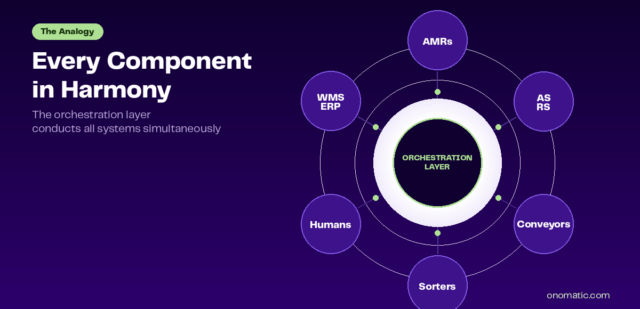
An orchestra contains many instruments and sections, each capable of playing its own part well but without a conductor to guide tempo, timing, and balance, the result isn’t music, it’s noise. A conductor ensures every instrument, no matter how different, contributes to the same piece of music at the right moment.
Thus, when looking to describe the automation environments of the future, orchestration emerged. Robots, conveyors, AS/RS systems, goods-to-person solutions, and human operators all perform specialized roles well but without a coordinating layer to guide the tempo and pace, even well-designed technologies will struggle to perform at the highest level.
Orchestration provides that role, ensuring every component performs its part in harmony with the rest of the operation.
The outcomes of using a traditional WES today are subtle at first:
- Work arrives faster than downstream equipment can process it
- Robots wait for inventory that hasn’t arrived yet
- Accumulation zones fill unexpectedly
- Operators intervene to rebalance flow
Individually, each system performs as expected but they cannot adapt to systems outside their control.
This is the structural limitation of a point-to-point execution model.
A New Architecture: Automation Orchestration
Automation Orchestration Platforms were created to address this exact challenge.
Rather than simply connecting systems together, an orchestration layer continuously interprets what is happening across the entire operation and re-optimizes and coordinates accordingly.
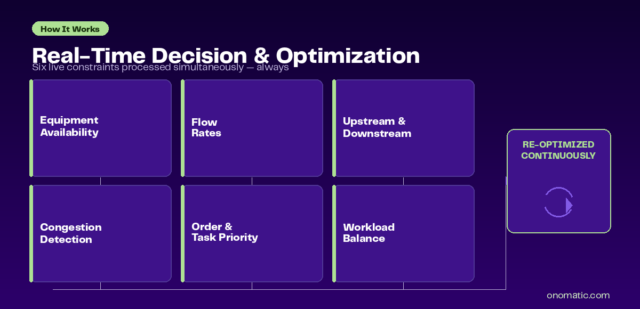
Instead of static handoffs between systems, orchestration introduces a continuous decision and optimization layer that, using site specific configured workflows understands:
- Equipment availability
- Flow rates
- Upstream and downstream constraints
- Congestion and accumulation
- Order & Task priority
- Workload balance across labor pools and shift

This allows automation assets from different vendors to operate as part of a coordinated system rather than integrated subsystems.
In practical terms, orchestration means that tasks are adjusted based on real-time conditions across the facility, not just within a single machine or subsystem.
Where WES Ends and Orchestration Begins
An Automation Orchestration Platform does not need to eliminate systems already present at a given site, but it often can if there is a benefit including simply reducing the number of systems to manage.
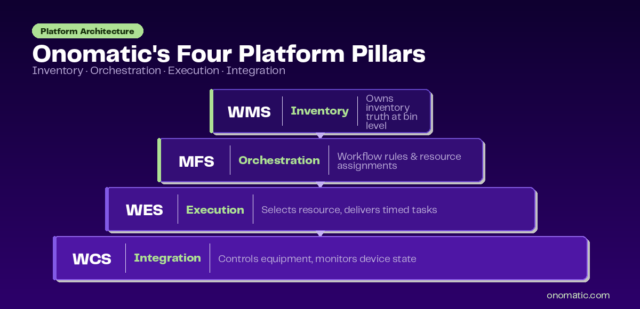
The WMS still manages inventory and order fulfillment.
Control systems still operate equipment safely and precisely.
Local execution layers still manage machine-level tasks.
What changes is the presence of a higher-level orchestration layer that sees and adapts the full operation and aligns across all automation technologies.
Why This Matters for the Future of Automation
With the exception of a new “Greenfield Site” most organizations are actively introducing new robots (AMRS), storage systems, sortation capabilities, packing systems and so on, incrementally, over time.
A little at a time can however lead to thinking that an integration middleware (WES) could be used but without orchestration, that approach does not set any operation up for the future.
By separating operational coordination from specific hardware systems, organizations gain the ability to efficiently introduce new technologies without rewriting the entire automation logic of the building.

The result is a more adaptable automation environment; one where systems from multiple vendors can be deployed at a given site through the use of the Orchestration Platform more efficiently than through one off integration without workflow orchestration.
The shift from Warehouse Execution Systems to Automation Orchestration reflects a broader change in how modern, future ready distribution centers and manufacturing plants operate.
And in increasingly complex automation environments, the ability to orchestrate automation equipment is crucial.
Is your warehouse technology stack falling behind? Book a demo to see how Onomatic can help.